High Blood Pressure in Senior Cats: Who Needs a Check and What the Numbers Mean
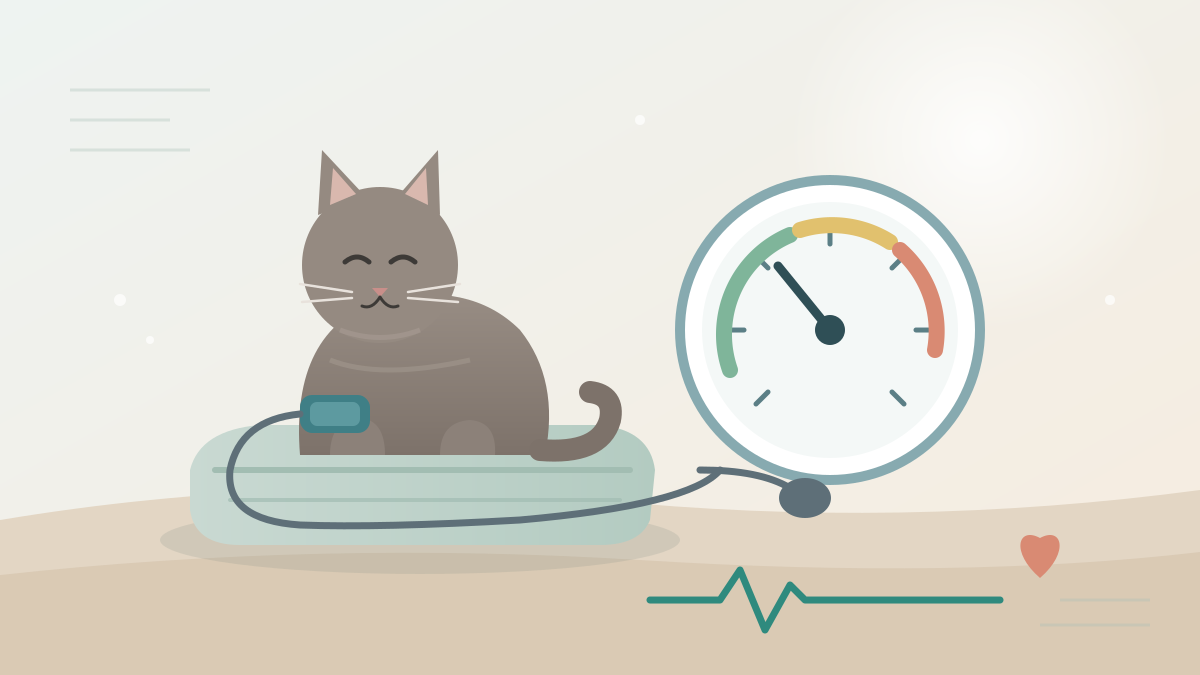
An older cat that eats, sleeps in the sun and greets you at the door does not look like a cat with a cardiovascular problem. That is exactly why high blood pressure in cats is so often found late. Many owners first hear the word "hypertension" on the day their cat suddenly bumps into furniture, or when a vet looks into the eyes during a routine visit and sees bleeding or a detached retina. The pressure had usually been climbing for a long time before that.
The good news is that hypertension is one of the few serious problems in older cats that a simple, painless test can pick up before it does harm. This guide covers which cats should be checked, how often, how a reliable reading is taken, what the numbers mean, and which changes at home call for the vet the same day.
Why a cat can look fine while the pressure climbs
Persistently high blood pressure damages tissues that are rich in small blood vessels. The Cornell Feline Health Center names the eyes, brain, kidneys and heart as the organs most at risk, and describes eye injury as the most common. The 2018 ACVIM consensus statement on hypertension in dogs and cats puts the problem plainly: in most cases hypertension is silent, and damage to target organs builds up over long periods of time. The same statement warns that the signs an owner or a vet might see can be subtle and easy to put down to old age.
Most high blood pressure in cats is secondary, meaning another disease is driving it. Cornell reports that at least 60% of cats diagnosed with hypertension also have signs of chronic kidney disease, and that about one in five cats with hyperthyroidism develops hypertension. Both diseases are common in older cats, which is a large part of why age matters so much here. If your cat already has a kidney diagnosis, the article on feeding a senior cat with early kidney concerns covers the diet side, and the one on weight loss and hyperthyroidism in senior cats covers the thyroid side.
Some cats have high blood pressure with no underlying disease found at all. The ACVIM panel cites a study of 133 apparently healthy cats aged 9 years or older that started with normal readings, in which 7% developed this idiopathic form during follow-up.
Which cats should be checked, and how often
Veterinary groups do not set exactly the same starting age, but they agree that blood pressure belongs in the routine care of older cats:
- All cats 9 years and older: the ACVIM panel does not recommend screening every cat of every age, because a single stressed reading in a young, healthy cat often gives a false alarm. It does consider annual screening of cats and dogs aged 9 years or older reasonable.
- Healthy senior and geriatric cats: the 2023 AAHA Senior Care Guidelines list a blood pressure check as strongly recommended every year for senior cats, and recommend it every 6 to 12 months for healthy geriatric cats.
- Cats 10 years and older: the American Association of Feline Practitioners, introducing its hypertension toolkit for vets, states that cats of 10 years and older are at higher risk and need to be monitored more frequently.
- Cats with kidney disease, hyperthyroidism or heart disease, at any age: Cornell advises regular blood pressure monitoring for these cats, and AAHA advises checking more often in pets with chronic kidney disease.
In practice, that means a blood pressure reading should be part of every senior wellness visit, alongside bloodwork and a urine test. If it has never been mentioned at your cat's checkups, ask for it when you book.
What the numbers mean
Vets measure systolic pressure, the peak pressure with each heartbeat, in millimeters of mercury (mm Hg). The ACVIM consensus groups readings by the risk of damage to target organs, using the same categories for dogs and cats:
- Below 140 mm Hg: normotensive, minimal risk.
- 140 to 159 mm Hg: prehypertensive, low risk.
- 160 to 179 mm Hg: hypertensive, moderate risk.
- 180 mm Hg or higher: severely hypertensive, high risk.
Cornell uses slightly different cut points in its owner guidance, calling a consistent reading below 150 mm Hg low risk and anything above 180 mm Hg high risk. Both sources agree on the point that matters most for owners: one high number on one day does not make a diagnosis. Unless the cat already shows damage, such as changes in the eye, the ACVIM panel asks for the high readings to be confirmed at repeat sessions. For readings between 140 and 179 mm Hg those sessions can be spread over 4 to 8 weeks; at 180 mm Hg or more they should be completed within 1 to 2 weeks.
Getting a reading that reflects the cat, not the car ride
A cat that has just been carried through a waiting room past barking dogs may have a temporarily high reading. Vets call this situational or "white coat" hypertension, and VCA Animal Hospitals notes that cats can have temporary rises in blood pressure from stress, including being in a veterinary hospital. The ACVIM protocol is designed around this problem. The reading is taken in a quiet area away from other animals, before other procedures, after the cat has had 5 to 10 minutes to settle. The first measurement is discarded, and the result is the average of 5 to 7 consistent readings. Whenever possible the owner should be present and restraint should be kept to a minimum.
The cuff goes around a front leg or the tail, and the vet uses either a Doppler device, which lets everyone hear the pulse as a whooshing sound, or an oscillometric machine. Neither involves needles. Owners can do a lot to make the number more accurate:
- Get the cat used to the carrier at home in the weeks before, leaving it open with bedding inside.
- Cover the carrier with a light towel in the car and in the waiting area.
- Ask for the blood pressure to be measured first, before blood is drawn or anything else is done.
- Ask whether a quiet room is available, and stay with the cat if the clinic allows it.
- If the reading comes back high, ask whether it was the average of several readings, and when the repeat check should be.
Signs at home that should never wait
Because hypertension is usually silent, the signs below tend to mean that damage is already happening. The ACVIM table of target organ damage lists acute onset blindness, retinal detachment, bleeding in the eye, seizures, altered mentation and other neurological signs. VCA lists sudden blindness, bleeding inside the eye, persistently dilated pupils, head tilt, disorientation, seizures, nosebleeds and blood in the urine. Cornell reports neurological signs in 15 to 40% of cats with hypertension.
Treat any of these as a same-day matter, and call an emergency clinic if your own vet cannot see the cat today:
- The cat suddenly bumps into things, misjudges jumps, or the pupils stay wide open in normal room light.
- Blood is visible inside one or both eyes.
- A seizure, a sudden head tilt, wobbly walking, or sudden confusion.
- A nosebleed with no injury.
Speed matters with the eyes. Cornell explains that blindness from hypertension can sometimes be reversed if it is treated very quickly, and that in most cases it is permanent. The ACVIM panel classes a severely high reading together with signs of brain involvement as a situation needing immediate emergency treatment. Living with a cat whose sight does not come back is covered in the article on vision loss in senior dogs and cats.
After the diagnosis: treatment and follow-up
Treatment has two parts: lowering the pressure and treating whatever is causing it. Cornell describes amlodipine, a small pill given once a day, as the first-choice medication in cats, with telmisartan or benazepril added or used instead in some cats, especially those losing protein in the urine. The ACVIM panel reports that cats with hypertension typically see a drop in systolic pressure of 28 to 55 mm Hg on amlodipine. Its goal for treatment is a reading below 140 mm Hg, and at minimum 160 mm Hg or lower. Your vet chooses the drug and the dose for your cat; none of these should be started, stopped or adjusted at home.
Treatment is usually lifelong, and the rechecks are part of the treatment. The ACVIM statement notes that because the disease is silent, owners can easily underestimate the follow-up, and it advises that an owner should never leave the clinic without a clear plan for reevaluation, including a booked appointment. VCA adds that periodic blood tests are needed to watch for side effects and for progression of any underlying disease. If giving a daily pill turns out to be hard, tell the vet early: the ACVIM panel recommends checking whether doses are actually being given before raising the dose of amlodipine.
A simple record to bring to every visit
Blood pressure is easier to manage when there is a history to compare against. A single page kept with the cat's papers, filled in at each visit, gives the vet and you a trend instead of isolated numbers:
- Date and clinic: where the reading was taken, since equipment can differ.
- Average systolic reading: and the category it falls into.
- Method and site: Doppler or oscillometric, front leg or tail, so later readings are taken the same way.
- How the cat seemed: calm, tense, or very stressed.
- Medication and dose at the time: including any change made that day.
- Other results: kidney values, thyroid level, and urine protein if measured.
- Next check date: written before you leave.
Add any eye or behavior change you notice at home between visits, with the date. That short note is often what lets the vet connect a gradual change to the pressure.
A pressure reading belongs in every senior cat checkup
High blood pressure in older cats is common, quiet and closely tied to kidney and thyroid disease. A calm, repeated reading taken in the right conditions catches it while treatment can still protect the eyes, brain, kidneys and heart. For any cat from about 9 years of age, and for cats with kidney, thyroid or heart disease at any age, ask for the reading at each wellness visit, keep a record of the numbers, and treat sudden blindness or neurological signs as an emergency.
Sources and further reading
- Hypertension, Cornell Feline Health Center
- ACVIM consensus statement: Guidelines for the identification, evaluation, and management of systemic hypertension in dogs and cats, Journal of Veterinary Internal Medicine, 2018 (PubMed Central)
- Hypertension in Cats, VCA Animal Hospitals
- 2023 AAHA Senior Care Guidelines for Dogs and Cats, American Animal Hospital Association
- American Association of Feline Practitioners Release New Feline Hypertension Educational Toolkit, American Association of Feline Practitioners
More on vet care & decisions
Mitral Valve Disease in Small Senior Dogs: From a New Murmur to Counting Breaths at Home
How Often Should a Senior Dog or Cat See the Vet? (It's Not Just "Every 6 Months")
Recognizing Quality of Life Decline in an Aging Pet: A Practical Framework